
Introduction
AI voice agent pricing reads like a single number on a landing page, then arrives as something larger on the invoice. The gap is not a trick so much as a bundling choice, and once you know the layers you can compare any vendor in minutes. This guide breaks down what an AI voice agent really costs per minute in 2026, where the hidden charges hide, and how to model your own monthly spend before you sign anything.
What AI voice agents cost per minute in 2026
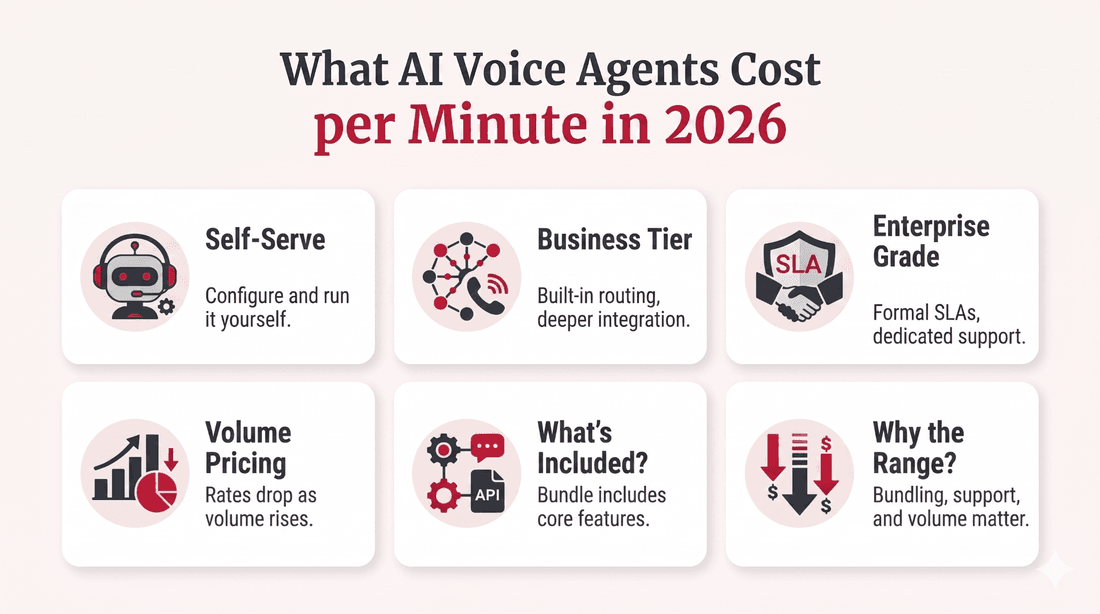
Across the market, published AI voice agent pricing spans a wide band: roughly $0.05 to $1.50 per minute, and enterprise voice with managed support can run past $2. The spread is not random. It tracks how much of the call stack the rate covers and how much hand-holding comes with it.
| Tier | Typical rate | What it usually means |
|---|---|---|
| Self-serve | $0.05 to $0.12 / min | You configure and run it yourself, often usage based with no minimum seat |
| Business | $0.50 to $1 / min | More integrations, support, and call routing baked in |
| Enterprise | $1 to $2+ / min | SLAs, dedicated support, advanced analytics and compliance |
A useful anchor: 9278.ai lists three usage tiers at $0.15, $0.12, and $0.10 per minute, with the rate dropping as your volume rises. That sits firmly in the self-serve band, which is where most teams should start before paying for managed layers they may not need yet.
Why does the same product span such a wide range? Three forces push the number around. The first is bundling, which we cover below: a low rate often means more line items live outside it. The second is support and accountability. A $1.50 rate frequently buys an SLA, a named contact, and someone to call at 2am, while a $0.10 rate assumes you run the agent yourself. The third is volume, since per-minute rates almost always step down as you commit more, because the vendor's own infrastructure cost falls with scale. None of these is good or bad on its own. The mistake is comparing a managed enterprise rate against a self-serve rate as if they were the same purchase. They are not, and the right tier depends on how much you want to own versus hand off.
The hidden layers behind the headline rate
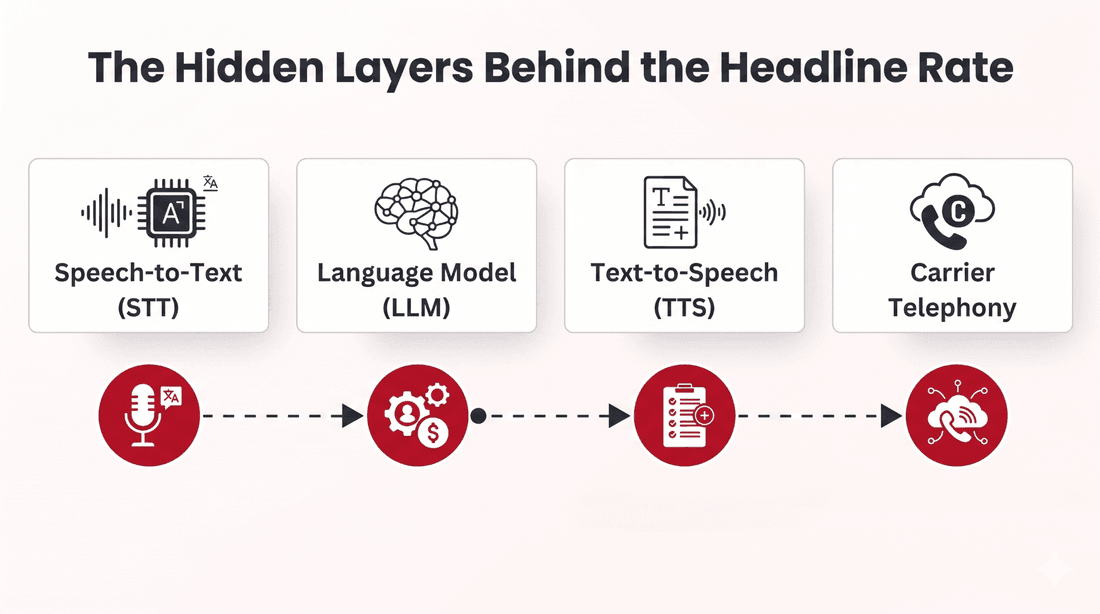
Most platforms advertise the orchestration rate, the cost of running the conversation loop. That figure often excludes the parts that actually make the call happen. When you stack them, a "$0.05" agent can land closer to $0.14 all-in.
Speech-to-text
Converting caller audio to text in cascaded systems, billed per minute of audio processed.
Language model
The reasoning that decides what to say. Heavier models cost more per token.
Text-to-speech
Turning the reply into a voice. Premium neural voices carry a premium price.
Telephony
Actual phone minutes over the PSTN. Often billed by your carrier, not the platform.
One design choice removes several of these layers. An audio-native engine that goes voice to voice skips the separate speech-to-text and text-to-speech meters, because there is no transcription or synthesis stage to bill. That is why 9278.ai folds the voice model into a single per-minute figure. Telephony stays its own clear line: route through the carrier you already use, or provision an optional number from the platform, with US numbers from $2 a month and other regions from $5. Either way the phone line shows up as a visible item rather than a markup buried inside the voice rate.
The practical test when you read any rate card is one blunt question: does this number include the language model and the voice, or just the loop that connects them? If the answer is vague, assume the worst and ask for an all-in figure in writing. A vendor that is confident in its pricing will give you one without flinching. A vendor that cannot, or will not, is telling you something about the invoice that is coming. Keep that habit and you will rarely be surprised by a bill.
Pricing models: prepaid credit, usage, and seats
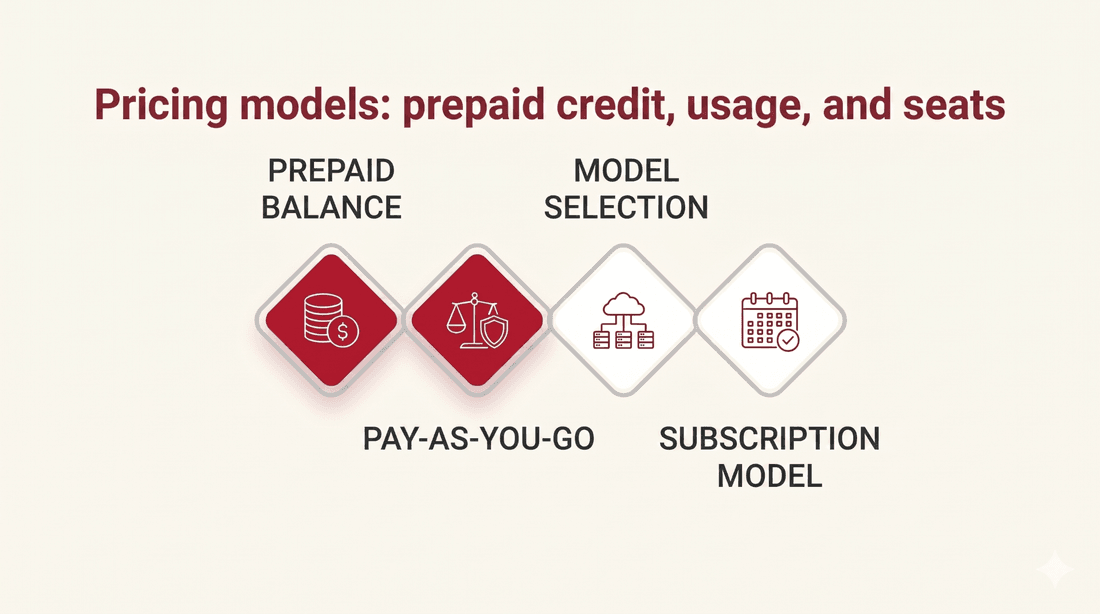
Beyond the rate, the billing model shapes your risk. There are three common shapes, and each rewards a different buyer.
Prepaid credit
You top up a balance and draw it down per minute. It caps your exposure and suits teams testing a use case. Watch the expiry window: some credit expires fast. As a reference point, 9278.ai uses $20, $50, or $100 top-ups with credit valid for 60 days.
Pure usage
Pay only for minutes used, no base fee. Clean for variable volume, but model a busy month so a spike does not surprise you.
Per-seat or subscription
A flat monthly fee, sometimes with minutes included. Predictable, but you pay whether the line is busy or quiet, which punishes seasonal callers.
There is no universally correct model, only a correct fit. A law firm with steady weekday intake may prefer the predictability of a subscription. A seasonal home-services contractor whose phones explode in July and go quiet in February is far better served by pure usage or prepaid credit, where the bill tracks the actual season. Map your call volume across a full year before you choose, and weight the busy months heavily, because that is when a poorly chosen model hurts most.
How to estimate your real monthly cost
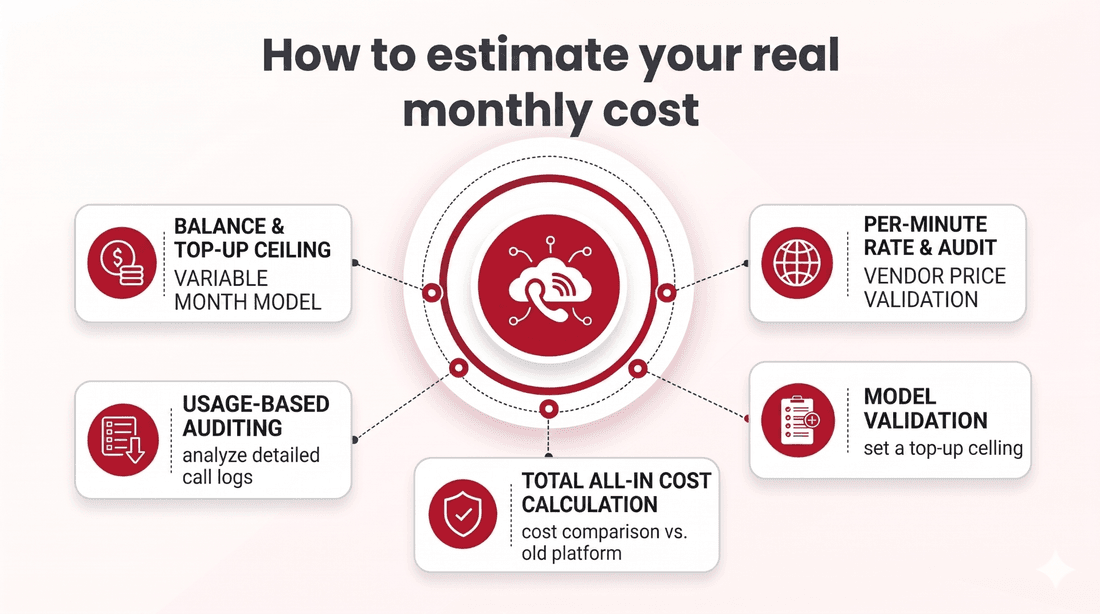
The math is simple once you separate voice from telephony. Use this order so nothing slips through:
Monthly voice spend = (expected call minutes) x (all-in per-minute rate)
Plus carrier telephony minutes, billed by your provider
Plus any fixed platform or seat fee
Worked example: a clinic expects 5,000 answered minutes a month. At a $0.12 all-in rate, the voice line is about $600. Telephony is separate, often a few cents a minute, and there is no seat fee on a usage model. The lesson is not the exact figure, it is the habit: get one all-in voice rate, then add phone minutes as their own line so you can audit both. Before you commit, it is fair and smart to price two or three vendors the same way and validate the numbers against your own call volume.
It also pays to compare against the cost you are replacing, not just rival platforms. A part-time human handling overflow and after-hours calls carries a wage, payroll tax, benefits, training, and the calls they still miss while on a break or asleep. When you put the AI voice line next to that fully loaded number rather than against zero, the per-minute rate usually looks small. The honest caveat is that minutes can run higher than you expect if calls are long or volume spikes, so model a busy month, not an average one, and set a top-up ceiling you are comfortable with. Used that way, a transparent per-minute rate becomes a budgeting tool rather than a guessing game.
Conclusion
AI voice agent pricing is only confusing when the layers stay hidden. Ask for an all-in per-minute rate, find out which of the five cost components it includes, keep telephony as its own line, and model a realistic month before signing. Do that and the cheapest sticker rarely wins; the clearest rate card does.
Frequently asked questions
How much does an AI voice agent cost per minute?
Published AI voice agent pricing runs from about $0.05 to $1.50 per minute in 2026. Entry self-serve platforms sit at $0.05 to $0.12, business tiers land near $0.50 to $1, and enterprise voice with managed support and SLAs can pass $2 per minute.
Why is my AI voice agent bill higher than the advertised rate?
Many platforms advertise only the orchestration rate. Your real bill can add speech-to-text, the language model, text-to-speech, telephony, and platform fees. Stacked together these can double or triple the headline number, so read the full rate card first.
What is included in a transparent per-minute price?
A transparent price folds the voice model, reasoning, and platform into one figure. Telephony is often separate because carriers bill it directly. Ask whether speech-to-text, text-to-speech, and concurrency are inside the quoted rate or added on top.
Do AI voice agent minutes or credits expire?
It depends on the provider. Some prepaid credit sets an expiry window. On 9278.ai, voice credit stays valid for 60 days from purchase, and top-ups start at $20 with no contract, so you commit only to what you expect to use.
How do I estimate my monthly AI voice agent cost?
Multiply expected call minutes by the all-in per-minute rate, then add carrier telephony and any platform fee. For 5,000 minutes at $0.12 all-in plus telephony, budget the voice line near $600 and confirm the carrier charge as a separate line.
Want to see it in action? Build your first agent or talk to the team.